How to Balance Saving with Discretionary Spending

A budget is the cornerstone of solid financial planning. Budgets help people know where their money is going, whether it’s the grocery store or their retirement account. An integral part of developing a functional budget is knowing how to balance saving money (for an emergency fund or a Roth IRA, for example) versus using money for discretionary spending. By definition, discretionary spending is money that is spent on non-essential, usually fun things.

It can be very easy to fritter money away in this manner if one is not aware of what is happening or how much is being spent. Fortunately, it is completely possible to balance saving and spending in a way that reaps the most benefits and brings the most joy to one’s life.

The first step is to identify what or how you love to spend your discretionary money. Perhaps you are a bookworm and love to buy new books the day they are released, or maybe you enjoy exploring new restaurants. By recognizing your passion, you can then be intentional about spending money on the experiences that bring you happiness. Experts caution that trying to completely eliminate our desires does not usually work well, but managing them and allowing ourselves the occasional indulgence can greatly enhance our quality of life.

It is important, however, to have boundaries on our discretionary spending, as this keeps it intentional. The aforementioned bookworm might allow herself two new e-books or one new hardcover book per month, and the restaurant aficionado might allow himself $50 for eating out each month. These special occurrences make life special, which is vital for a balanced lifestyle.

Along with practicing intentional spending, there are some basic money rules that should be observed when balancing saving and discretionary spending. It is essential to pay all your basic bills before you commit to any discretionary spending. Things like rent, car insurance, groceries, tuition, and utility bills are a necessary part of life, and you should never ignore them in favor of the fun spending.

Do not use credit cards or take out loans to go on vacations or buy expensive boots; this is poor financial planning. It is possible to have a responsible and joyful life if you make wise decisions regarding your money and how you spend it.

This article was originally published at DavidCBranch.com.

Personal Finance Tips for the Holiday Season

In addition to overeating, overspending is a bigger problem during the holidays. In order to keep from building up massive amounts of debt that will haunt you throughout the new year, it’s important to take preventative measures. These tips can help you keep your holiday expenditures in check.

Create a Holiday Spending Budget

The first thing you should do is determine how much cash you can spend this holiday season. This amount should not include your available credit, and you should resist the temptation to use your cards for gifts. Anything you purchase should be done with cash, and your spending should not compromise the rest of your household budget.

Keep Your Gift Buying List Short

You don’t have to buy gifts for all of your nieces, nephews, and cousins. In fact, many finance experts recommend that you don’t give many gifts to those outside of your immediate family. This will give you the opportunity to spend more money on your closest loved ones without going outside of your holiday spending budget.

Use the Internet

Before you hit up your local stores, spend some time browsing the internet for better deals. Many popular commercial websites extend online Black Friday deals up until the last few days before Christmas, making online ordering more advantageous. Additionally, some sites offer coupons that will save you even more money. Taking advantage of virtual sales and discounts will help you get more for your money.

Loved Ones Still Appreciate Homemade Gifts

Even if you’re not crafty, you can still make worthwhile homemade gifts. One popular idea is to make a booklet of coupons that your loved ones can cash in throughout the year. Some ideas include one free hug, a chore-free day, or a romantic night out for a significant other. You can also spend more time with parents and grandparents who will all appreciate the extra time with you.

While you may want to do more for others during the holidays, it’s important to remember the dangers of overspending. If you build up too much debt, you could end up in a situation that would destroy your credit for years. It’s better to spend less money to ensure your own finances will survive the holiday crunch.

Miss Geico Boat Racing Overview

Offshore power boat racing became an official sport in 1903 when members of the Automobile Club of Great Britain and the Marine Motor Association decided to organize a competition. Not long after that, the American Powerboat Association was formed. The first recorded offshore race was conducted in California in the year 1911.

Offshore powerboat racing has gained fans ever since. The sport is funding by a combination of private company funding and commercial sponsors. One of the most high-profile and successful teams today is Miss Geico owned by AMF Riviera Beach. It’s located in Riviera Beach, Florida.

Miss Geico holds numerous world speed records and has gained several national and world championships since launching in 2005. The team now holds 10 world titles. In all, Miss Geico has won 100 races. The club generally faces stiff competition from teams in Norway, Qatar and Australia, not to mention fellow American teams.

Top-of-the-line powerboats today fly across the water at speeds in excess of 200 mph. High-tech boats feature engines with an excess of two to three thousnds horsepower muscle. Of course, the goal is to coax as much speed as possible out of each boat, but operators must also execute sharp turns and hair-raising manuevers while keeping the hull in the water.

Without a doubt, this makes offshore powerboat racing one of the most dangerous sports in the world. The drivers are highly skilled, however, and the thrill factor is off the charts, including for spectators.

Miss Geico’s current flagship racer is a 9,500-pound craft made from carbon fiber and Kevlar. It features two 1,100 hp engines giving it a total of 2,200 hp. the Miss Geico team also sports a second-generation catamaran-model boat that ist used to win its third and fourth world championships. It’s top speed in nearly 200 mph. It’s behemoth T53 703 turbine engines pack 3,700 horsepower.

A third Miss Geico boat is the Victory Catamaran. It’s a fourth generation 50-foot vessel weighing in at 12,000 pounds. It is fitted with a 1650 RACE Sterndrive Mercury racing piston engine that generates 3,300 horsepower. It can exceed 200 mph.

Miss Geico has carved out a reputation as among the most successful offshore racing teams in the world since it entered competition in 2005.

This article was originally published at DavidCBranch.net.

Flags Used in Powerboat Racing

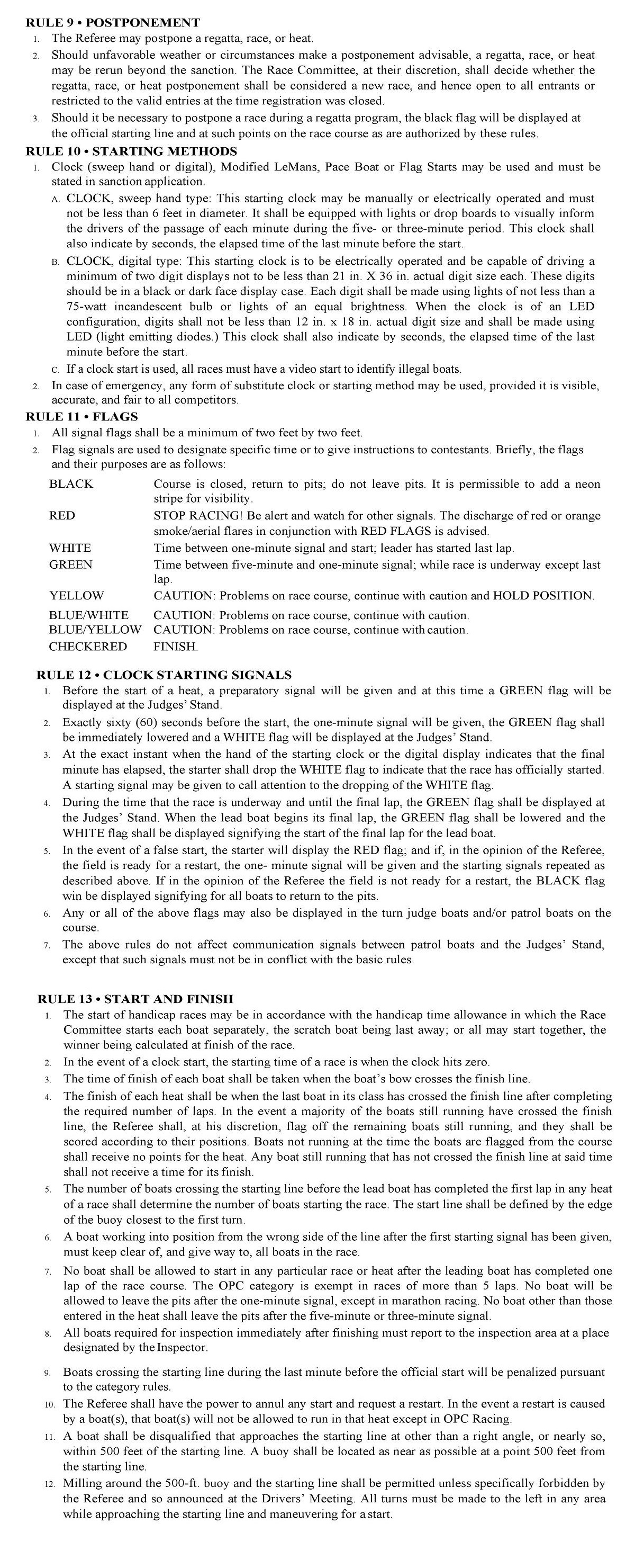
Flags are an integral part of powerboat racing. Whether you are a curious spectator or amateur racer, you will want to know the meaning of each flag and how flags are used during a race. Regulations for this sport define that flags used for powerboat racing must be at least 24”x24” to ensure that racers can easily see the flags. In addition to the size of the flags, each has a distinct color and corresponding meaning.

GREEN FLAGS

Green flags are used in powerboat racing for a few situations. A green flag is displayed just prior to the race to let participants know to be ready for the start. A green flag is also used to indicate the time between the signals for five minutes and one minute. Green flags are often used during a powerboat race.

WHITE FLAG

The white flag is used during the race to let competitors, pit crew, and spectators know that the leading boat is in the final lap. A white flag is also used to indicate one minute to start.

YELLOW FLAGS

Yellow flags are cautionary in powerboat racing. Racers do not have to return to their pits, but should exercise caution. The yellow flag indicates that there are problems on the course, and racers must maintain their positions until the flag is cleared.

BLUE FLAGS

Blue flags are used in powerboat racing to let racers know that they should exercise caution. The difference between yellow flags and blue flags is that racers do not have to hold position when blue flags are shown.

RED FLAGS

A red flag indicates a serious problem on the course. When a red flag is shown, racers are to stop racing. Red flags are sometimes accompanied by orange or red flares.

BLACK FLAGS

Black flags are used in powerboat racing to indicate that the race course is closed, and racers must return to their individual pit areas. This may be due to an accident or debris in the water that places racers and spectators at risk. Some black flags used for powerboat racing have neon stripes to make them more visible in certain weather conditions.

CHECKERED FLAGS

Checkered flags are the most recognized in powerboat racing. When a checkered flag is waved, the race is over, and the winners have been determined.

This article was originally published at DavidCBranch.net.

How to Care for Your Powerboat

Owning a powerboat allows you to conveniently enjoy the thrill that comes with speeding in the open waters. However, powerboats need a great deal of investment in terms of maintenance. Failure to maintain your powerboat will result in rapid structural deterioration, and soon you may have to deal with frequent breakdowns. Here are some ideas on what to focus on when caring for your powerboat.

Keep It Clean

Cleaning your powerboat regularly is the most crucial maintenance aspect that will guarantee to retain its pristine look. Neglecting the regular cleaning recommended on your powerboat will result in the accumulation of dirt, which may degrade the fiberglass coating and cause it to rust. Regularly wiping the boat’s interior and exterior surfaces also allows you to see and address any gradual build-up of structural issues, such as cracks and rust.

Get an Inspection

Just like a normal personal car, it is important to schedule a regular inspection on your powerboat. A thorough powerboat inspection is targeted at maintaining its pristine condition while also noticing any structural damage right on time. A thorough inspection also includes a checkup of the engine, which is the single most important part of your boat. The highly trained professionals who conduct a thorough inspection also can capture problems that would go undetected to the untrained eye.

Engine Checks

Proper powerboat maintenance should also include regular checks on the engine. Checking the engine oil, preferably once each day before you go for a ride, ensures that you capture slight reductions in the levels. The worst thing you could do to your powerboat engine is running it on low oil levels as this would cause the engine to knock. You should also target changing the engine oil at least once after every couple hundred hours of riding.

Check the Engine Hoses

Engine hoses are some of the most delicate parts of your engine, as they are highly susceptible to cracking and breaking. Checking the engine hoses regularly allows you to capture any unnoticed detail whose neglect may escalate to serious problems. On average, most engine horses have a lifespan of up to 10 years, after which they should be removed and replaced as they tend to be too brittle.

This article was originally published at DavidCBranch.net.

How to Build Credit

If you have found that your credit score is a bit too low to qualify for credit cards, loans, and larger purchases, you may be surprised to learn that there are simple ways to bring it up. Here are some proven strategies that you should try:

1. Refrain from Closing Credit Card Accounts

You may think this is logical if you aren’t using them, or you can’t afford them. However, closing such accounts means you can’t include the limits on them when your overall credit utilization is assessed, which lowers your credit score.

2. Don’t Let Credit Errors Slide

Did you know a mistake on your credit report, through no fault of your own, could seriously affect your score?

Fortunately, you are entitled to one free credit report, once a year, from all three bureaus. You can scan them for errors and dispute any that you may find. The credit bureaus have one month to investigate your claims, and, if you are correct, the negative remarks are removed.

3. Try Other Types of Credit

If you only have loans from the bank, apply for credit cards. If you only have installment accounts, try a revolving credit card. Varying your credit can boost your score indefinitely.

4. Seek Higher Limits on Existing Accounts

If your balances remain the same, yet your limits increase, you are sure to establish your credit worthiness.

5. Don’t Pay Bills Late

Regardless of the use of any other strategy, if you pay your bills late, your credit score will decrease.

This is because payment history is the most important piece of data in the algorithm that determines your credit score, and each month you are late makes things worse. As a matter of fact, late payments can affect your score and stay on your report for seven years!

6. Ask a Friend for Help

Ask a trusted buddy with a fantastic credit history if you can become an authorized user on one of their credit cards with an above-average limit.

You can do this on paper only, and do not even have to use the card, therefore, there is no risk to the account holder. Simply having your name attached to a high-limit account broadens your credit limit and payment history.

In conclusion, just by following these simple tips, you can increase your credit score little by little. This will do wonders to improve your quality of life, since you will now qualify for loans and credit cards with higher limits and better terms.

This article was originally published at DavidCBranch.com.

How to Save For Education

Based on a survey reported to US News, the average tuition last year was roughly $41,000 for private colleges to $11,000 for public colleges. The numbers are only expected to get higher in the following years to come. Considering another survey from Bankrate that shows average American households only having $8,800 in savings, these two figures are alarmingly disproportionate. If you’re in the same boat and want to save up for your kid’s education as early as possible, here are four tips:

Open a 529

Most personal finance articles only talk about 401ks and IRAs and few tackle the lesser-known 529 plan. It’s essentially a savings plan that is sponsored by the state government to encourage families to save up for future education expenses. Contributions made to a 529 plan are often tax-deductible. Each state offers a slightly different 529 plan, so make sure to check out which state’s 529 plan is right for you before signing up for one.

Invest in Stocks

Stocks are a relatively safer option than currencies or commodities but are a lot better at growing your initial capital than a traditional savings account or treasury bond. That being said, you’ll want to carefully select what stocks you invest in for long-term growth. Use stock screeners to narrow down the best performing stocks within the time frame you are looking to invest in the market.

Consider a Roth IRA

Roth IRAs are synonymous to retirement plans, but it doesn’t necessarily mean that’s all it’s good for. A Roth IRA can be a great investment plan for tax-exempted dollars as long as the taxpayer makes the proper distributions. Unlike a 529 plan, however, relatives cannot contribute to a Roth IRA plan, so make sure to weigh the pros and cons of each plan to get the best possible savings over time.

Consider a Permanent Life Insurance Policy

Often used by high net worth families as a savings strategy for their kid’s higher education, a permanent life insurance policy is essentially a traditional life insurance plan but with the added feature of having some of the money go into a death benefit and another portion going into a tax-exempted account.

Time flies and saving as early as possible is important to ensure your child gets the best choices for his/her higher education. Use these tools as a way to save more over time in addition to healthy money management habits.

This article was originally published at DavidCBranch.com.

Mistakes to Avoid When Saving for Retirement

Retirement is supposed to be a great time in your life where you can finally relax after years of hard work. Unfortunately, far too many people are unable to maximize the benefits of retirement due to a lack of savings. It is hard to find much relaxation time when you are struggling to survive financially every month. These are the four biggest mistakes to avoid when saving for retirement.

No Financial Plan

The only way you can truly know if you have saved enough for retirement is by creating a financial plan. This plan must include all of your expected expenses and income until you reach the end of your expected lifespan. Living in a home you have owned for decades is far cheaper than moving to a retirement community in an exotic location. This plan will also let you determine the type of lifestyle you can have during retirement.

Failing to Save

The best way to prepare for retirement is by saving as much as possible right now. This savings strategy will make you a lot of money in the future thanks to compound interest. The longer your money sits in a retirement savings account, the more it will accumulate in interest. It is best to only undertake big expenses when they are absolutely necessary. You will thank yourself when you get older.

Spending Too Much

You are going to have a hard time saving enough money for retirement if you are unable to control your spending. This is especially true if you cash out part of your retirement plan early. In addition to losing the future interest earnings, you will also have to pay taxes and huge early withdrawal fees on this money. Get your spending habits under control to ensure you do not have to keep working until death.

Bad Investment Strategy

There is nothing worse than losing a large portion of your retirement savings because of bad investments. While it may be tempting to take risks with your investments, this will likely come back to haunt you in the future. It is best to stick to safe investments like mutual funds and proven stocks. This will allow you to gradually build your savings over the years until you hit retirement age.

This article was originally published at DavidCBranch.com.

How to Cut Costs and Save During a Pandemic

The current global pandemic has rapidly transformed life as we know it. Both individuals and businesses have had to adjust nearly overnight. Many people are trying to figure out how to save money during these challenging times. One of the most important things you can do is cut back on costs. Personal finance advisor and entrepreneur Ramit Sethi compares cutting costs to flossing. He says “we all know we should do it, but most of us never get around to it.” A failure to cut costs often leads to a sense of guilt, but many people also find themselves crippled when it comes to making a decision on what to cut back on. 

Focus on Your Most Important Needs

If deciding what to keep and what to cut out is overwhelming, try to think about your top three expanses. Choose to focus on those. Some, like rent and electric bills, are necessary. You may be able to negotiate them to a lower number, depending on your situation. Other costs, such as buying new clothing and eating out, are easy to cut back or eliminate completely. During the pandemic, most restaurants and bars are closed, which makes taking out one large expense easy. 

Create Smaller Goals

Many people set high goals for themselves, and then become completely discouraged when they don’t accomplish them immediately. If you have a specific financial goal that you want to accomplish, it’s often enough to get most of the way there, feel good with your success, and move on. Don’t get stuck in a cycle of not meeting your goal, beating yourself up, and becoming too disheartened to create new goals and keep improving. 

Automate Your Savings and Bills

One of the best financial choices you can make is to have money automatically deducted from your paycheck and put into a savings account. This way you won’t be tempted to spend it. If you don’t use automation, you’ll be relying on yourself to remember to put the money away each month. You may find yourself spending it on purchases you don’t necessarily need, instead. 

You can also automate many of your bills too, from car insurance to utilities. Some companies offer slight discounts if you sign up for automatic payments. 

Taking these steps will help you save money during a pandemic and set you up for future financial success. 

This article was originally published at DavidCBranch.com.

A Glossary of Investment Terms for Beginners

Understanding how the investment world works is difficult without an understanding of its terminology. A finance major might see investment terms as basic knowledge, but financial jargon is confusing to everyone when investment decisions are made in fast-moving markets. Here are some industry terms to guide your investment strategies with:

The Ask and Bid Prices

The “ask” price is a price that an asset sells for while the “bid” is the price at which it is bought at. 

Buying and selling are identical to a degree, for you can only sell if someone buys, yet the difference between the ask and bid prices establish the cost of your transaction via what’s called “a spread.” Spreads, which show the difference in ask and bid prices, are what pay your broker. Many brokers earn commissions by selling at prices higher than what the market quotes—while buying at prices below market levels. 

The Broker and Your Blue-Chip Stocks

A true “broker” is a financial firm that takes your investment order and fills it on your behalf. 

Brokering is complicated, for it requires financial agencies to often use their own money to complete your trade through. Brokers encourage their clients to invest into the most profitable, liquid and dividend consistent “blue-chip stocks.” Blue-chip stocks are “the cream of the crop” in equity investing.

Bullish and Bearish Markets

A “bear,” as he relates to the investment world, is someone who takes a selling position for an asset or its market. 

“Bulls” buy equity up—in hopes that prices are set to rise even higher. A market that trends downward over a period of one or more months is bearish. A market that consistently trends upward with higher prices is a bullish one. Investors track bearish and bullish sentiment as a way of refining their investment decisions. 

Routine-Dividend Payouts

A stock company with dividends gives its shareholders scheduled payments apart from their stock ownership. Dividends are paid out via a yield percentage that tells us how much a dividend is worth based on its stock’s-full value. A 100-dollar stock, for example, with a yield of 7% will give a shareholder $7-per share either quarterly or annually.

This article was originally published at DavidCBranch.com.

Design a site like this with WordPress.com
Get started